How Downspouts and Gutters Work Together in Bushnell During Heavy Summer Rain
Summer rain in Bushnell does not ease in politely. It can arrive fast, fall hard, and keep coming long enough to show every weakness around a roofline. On a dry day, gutters and downspouts are easy to ignore. Once the afternoon sky opens up, they become one of the most important drainage systems on the house.
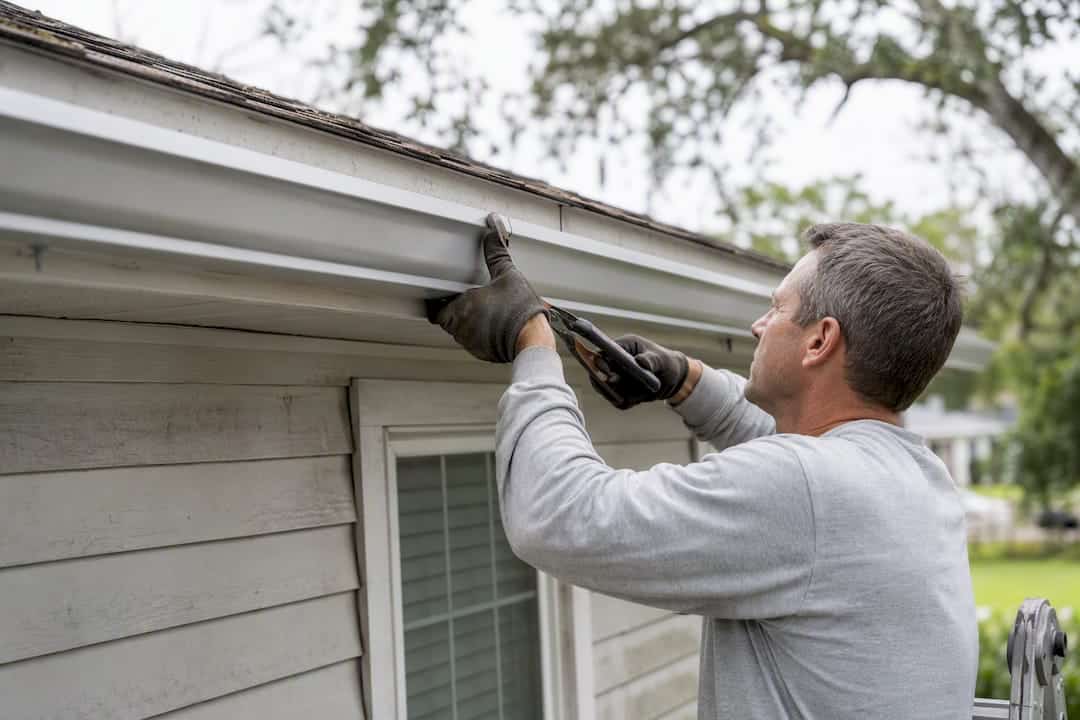
Most homeowners think of gutters as the part that catches water and downspouts as the part that sends it away. That is true, but it leaves out the part that matters most during a Florida summer storm: they only work when they are sized, pitched, attached, and kept clear as one complete system. A good gutter with a clogged downspout still fails. A wide downspout tied to a sagging gutter still fails. When rain is coming off a roof in sheets, the handoff from gutter to downspout has to be smooth and continuous.
That is why storm ready gutters Florida homeowners trust are never just about the horizontal channel along the eaves. The real performance comes from the connection between the roof edge, the gutter trough, the outlet, the downspout, and the final discharge point on the ground.
What the gutter actually does when rain turns heavy
A roof sheds water quickly. Once rain lands on shingles or another roofing surface, gravity pushes it downslope toward the eaves. At that edge, the gutter’s job is to intercept the runoff before it drops directly next to the house. If there were no gutter at all, heavy water would pour straight off the roofline, hit the soil below, and concentrate in a narrow zone around the foundation and planting beds.
In Bushnell and nearby parts of Central Florida, summer weather adds pressure to that system. Humidity keeps organic debris damp. Afternoon storms can dump a lot of water in a short window. Tropical weather raises the stakes even more. University guidance for Florida storm preparation specifically warns that gutters and storm drains can clog with debris, and it recommends clearing needles, leaves, and other debris from roofs and gutters. That advice sounds simple, but it points to a practical truth: even a well-built gutter can lose capacity fast when the flow path narrows.
Water moving through a gutter is not static. It needs room to enter, room to travel, and a slight pitch that encourages it toward the outlet. If leaves, oak litter, or pine needles build up in the channel, rainwater can start ponding instead of moving. Once that happens in a hard storm, overflow usually shows up at the exact places homeowners notice first, over a front entry, behind a landscaping bed, or at a corner where splashback stains the siding.

Why the downspout matters just as much as the gutter
A gutter without an effective downspout is like a sink with no drain. The channel may catch the water for a moment, but it has nowhere to go. The downspout is what turns collection into drainage.
This is where a lot of performance problems show up. Homeowners sometimes focus on the visible gutter line and miss the fact that the outlet into the downspout is the choke point. In lighter rain, a partially obstructed outlet might not cause obvious trouble. In a typical Florida summer downpour, it can back water up almost immediately. Once the gutter fills beyond its working depth, the overflow can shoot over the front edge or spill behind the gutter, depending on the installation and where the blockage sits.
Good downspout drainage Newberry FL contractors talk about the same way local pros do elsewhere comes down to one basic goal: get roof runoff away from the house in a controlled path. The downspout needs to carry the water down the wall and release it where it will not simply pool against the structure or erode the soil right at the base.
That last part is often overlooked. The gutter and downspout can perform perfectly at the roof and still create trouble at grade if all that water is discharged into one overworked spot. During repeated summer storms, concentrated runoff can carve mulch beds, expose roots, and turn a clean side yard into a muddy channel.
Gutters and downspouts are one drainage chain
When I look at a rainwater problem on a house, I do not separate the gutter from the downspout. I follow the path of the water. It starts at the roof surface, then enters the gutter, then moves toward the outlet, then drops through the downspout, then exits at ground level. A problem at any point in that chain affects every point before it.
That is why Florida code language around gutters and downspouts matters. Gutters and leaders need to be sized and discharged in accordance with the Florida Building Code and related plumbing requirements, and exterior gutters and downspouts should be made of metal or approved plastic and securely fastened with corrosion-resistant fasteners. The practical takeaway is not legal jargon. It is that these components are expected to handle weather exposure and direct water intentionally, not casually.
In day-to-day terms, “working together” means all of the following are happening at once: the gutter has enough capacity for the roof area it serves, it is sloped properly toward the outlet, the outlet is not pinched by debris, the downspout is clear, the fasteners are holding, and the discharge area can accept the water. If one of those points breaks down, the entire system starts acting smaller than it really is.

Why Florida debris changes the equation
Bushnell homeowners do not just deal with rain. They also deal with the debris that rain moves around. Florida landscapes commonly drop pine needles, oak leaves, acorns, and other yard material. University guidance notes that these materials should be kept out of gutters and storm drains, not only because they interfere with drainage but also because runoff can carry that organic matter into waterways. It also points out that fallen leaves and pine needles can be reused on-site as mulch rather than left where they wash away.
That matters because not all clogs behave the same way. A handful of dry leaves may blow through or sit harmlessly for a while. Wet pine needles can knit together into a mat that acts almost like felt over a downspout opening. Oak litter can collect in layers, especially where there is not enough flow to carry it toward the outlet. Add summer humidity, and the debris gets heavier, stickier, and harder to flush naturally.
This is one reason gutter guards for pine needles Florida homeowners ask about can be a useful conversation, but not a magic answer. Guards may reduce the volume of debris entering the trough, depending on the design and the type of debris around the house, yet they still need inspection. Fine material can collect on top, and some systems can still allow small organic matter into the gutter. The right question is not whether a guard eliminates maintenance. It is whether it reduces the kind of clogging your specific roof and tree mix tend to produce.
The sizing question homeowners ask, and the honest answer
A lot of people want a simple one-size-fits-all rule for gutter sizes for Florida homes. Real life is not that tidy. Proper sizing depends on the roof area feeding a section of gutter, the layout of valleys and slopes, and how quickly water concentrates toward a given edge. Code requires gutters and downspouts to be sized appropriately, but the exact dimension choice should be based on the house, not on a generic guess.
That said, the principle is easy to understand. The more water a roof section collects, the more gutter installation in Central Florida capacity the gutter and downspout need to move it. A steep roof or a roof section that funnels water into one area can stress a system much more than a simple straight run. That is why two homes on the same street can need different solutions even if they look similar from the curb.
If you are comparing options such as K-style gutters Lady Lake FL homeowners often prefer, the shape itself can be part of the capacity and appearance discussion. K-style profiles are common because they fit many homes visually and can handle runoff effectively when properly designed and installed. What matters most is not the style name alone but whether the whole assembly suits the roof it is serving.
Materials, fasteners, and Florida weather
Material choice affects durability, maintenance, and how the system holds up over time. Aluminum gutters Central Florida homeowners choose are popular for practical reasons, especially where corrosion resistance and manageable weight matter. Exterior gutter systems live in heat, humidity, and repeated wet-dry cycles. Fasteners and attachments matter every bit as much as the trough material because a gutter that loosens from the fascia cannot keep its pitch.
When Florida building guidance says these systems should be securely fastened with corrosion-resistant fasteners, that speaks directly to long-term performance in this climate. A loose joint or failing attachment may start as a minor alignment issue. During a hard rain, that small movement can change how water flows, create a low spot where debris settles, or let the gutter tilt enough to spill.
Seamless gutters Ocala FL contractors frequently recommend are another example of a practical performance choice. Fewer joints can mean fewer places for leaks and debris snags to develop along the run. It does not make the system maintenance-free, but it can reduce some common trouble spots.
What failure looks like during a Bushnell downpour
A gutter system rarely fails all at once. Usually it gives a series of hints before the big overflow that gets your attention. During normal rain, you might hear dripping at one corner long after the storm passes. You might notice a dark stripe on the fascia, splash marks on the siding, or a mulch bed that keeps washing out in one place. Then summer hits, rain intensifies, and the system reaches the point where the weak area can no longer cope.
In the field, I tend to see five recurring patterns:
- Water shoots over the front edge because the gutter cannot move flow toward the outlet fast enough.
- Water spills behind the gutter when debris dams it up or when attachment and pitch have drifted.
- A downspout clogs at the top opening, so the gutter fills as if the downspout were not there.
- The discharge point dumps too close to the house, leading to pooling and erosion at grade.
- Organic buildup stays wet for long periods, adding weight and slowing drainage in the next storm.
None of these are exotic failures. They are ordinary, familiar, and usually preventable. The trick is catching them before the wettest part of the season exposes them at full force.
Why cleaning is not just cosmetic
Some homeowners see gutter cleaning as a neatness issue. In Florida, it is a drainage issue first. UF/IFAS maintenance guidance for stormwater systems specifically recommends cleaning gutters and downspouts as needed and removing organic buildup, especially in summer. That wording matters because summer is exactly when clogging and high flow combine in the worst way.
Gutter cleaning Fruitland Park FL service calls often spike after a storm reveals a problem, but the better timing is before repeated heavy rains set in. Cleaning removes the obvious blockage, yet a good service visit should also check whether the downspout is flowing freely, whether outlets are obstructed, and whether any standing water is sitting in the trough after the debris is gone. A clean gutter that still holds water may have a pitch issue or a partial downspout blockage farther down.
Another reason to stay on top of debris is environmental. Florida extension guidance notes that leaves, acorns, and related yard litter can become part of stormwater pollution when runoff carries them away. Keeping that material out of gutters and storm drains is not only good for the house. It is better for the broader drainage system too.
Repair versus replacement, and when each makes sense
Not every problem calls for a new system. Gutter repair Wildwood FL homeowners seek often involves fixing loose sections, resecuring attachments, clearing blockages, or addressing isolated leaks and drainage issues. If the gutter body is still sound and the layout is basically correct, repair can restore performance without overcomplicating the job.
Replacement enters the picture when the underlying design is wrong for the roof, when repeated leaks and sagging suggest the system is at the end of its useful life, or when multiple sections have failed in ways that make piecemeal fixes wasteful. Gutter replacement Gainesville FL projects tend to make the most sense when the owner is tired of chasing the same overflow pattern every rainy season.
A useful way to think about it is this: if the trouble comes from maintenance and a few localized defects, repair is often reasonable. If the trouble comes from poor capacity, chronic misalignment, or widespread deterioration, replacement may be the cleaner long-term answer.
A few practical checks before the next storm cycle
Most homeowners do not need to become drainage experts, but they do benefit from knowing what to look for around the house before summer weather gets serious.
- Check for visible debris at roof edges, in gutter runs, and at downspout openings.
- Watch where downspouts discharge and note whether water pools near the house.
- Look for stains, splash marks, or eroded mulch below common overflow points.
- After rain, see whether water lingers in the gutter instead of draining out.
- If any section appears loose or uneven, have it evaluated before the next heavy storm.
That short walkaround can save a lot of frustration. You are not trying to diagnose every detail. You are looking for clues that the gutter-downspout chain is already under strain.
Hiring someone who understands Florida conditions
Hiring a gutter contractor Florida homeowners can trust is less about finding the cheapest quote and more about finding someone who understands how these systems behave in local weather. Bushnell is not dealing with the same pattern as a milder, drier region. Here, summer rain intensity, seasonal storms, humidity, and tree debris all shape what good workmanship looks like.
A solid contractor should be willing to talk through more than the gutter profile. They should discuss drainage paths, debris patterns, fastening methods appropriate for exterior exposure, and how discharge is handled once water reaches the ground. If the conversation never gets past color and price, that is not a great sign. Appearance matters, but function comes first.
It also helps when the contractor is candid about trade-offs. For example, gutter guards may help in one yard and offer only modest benefit in another. A repair may be sensible for one elevation while another section really needs replacement. Honest recommendations usually sound specific, not generic.
The small details that decide whether the system keeps up
Two houses can have similar gutters and very different results in a downpour because the small details decide everything. A single downspout set in the wrong place can leave too much runoff traveling too far inside the gutter. A slightly loose run can create a low spot where wet debris collects. A discharge point aimed into a bed with poor drainage can turn a roof runoff solution into a ground runoff problem.
That is why “gutters and downspouts” should never be treated as separate purchases or separate maintenance tasks. They are one system with one job: catch roof water, move it efficiently, and release it where it will do the least harm. In Bushnell during heavy summer rain, that job gets tested hard and often.
When the system is clear, properly fastened, appropriately sized, and thoughtfully discharged, it usually goes unnoticed. Water enters, travels, drops, and exits with very little drama. That quiet performance is exactly what you want. If you are hearing overflow, seeing washout, or watching water pour where it should not, the message is simple. The gutter and the downspout are no longer working together, and summer in Florida is not forgiving about that for long.
Ends · EXTERIORGUIDE597